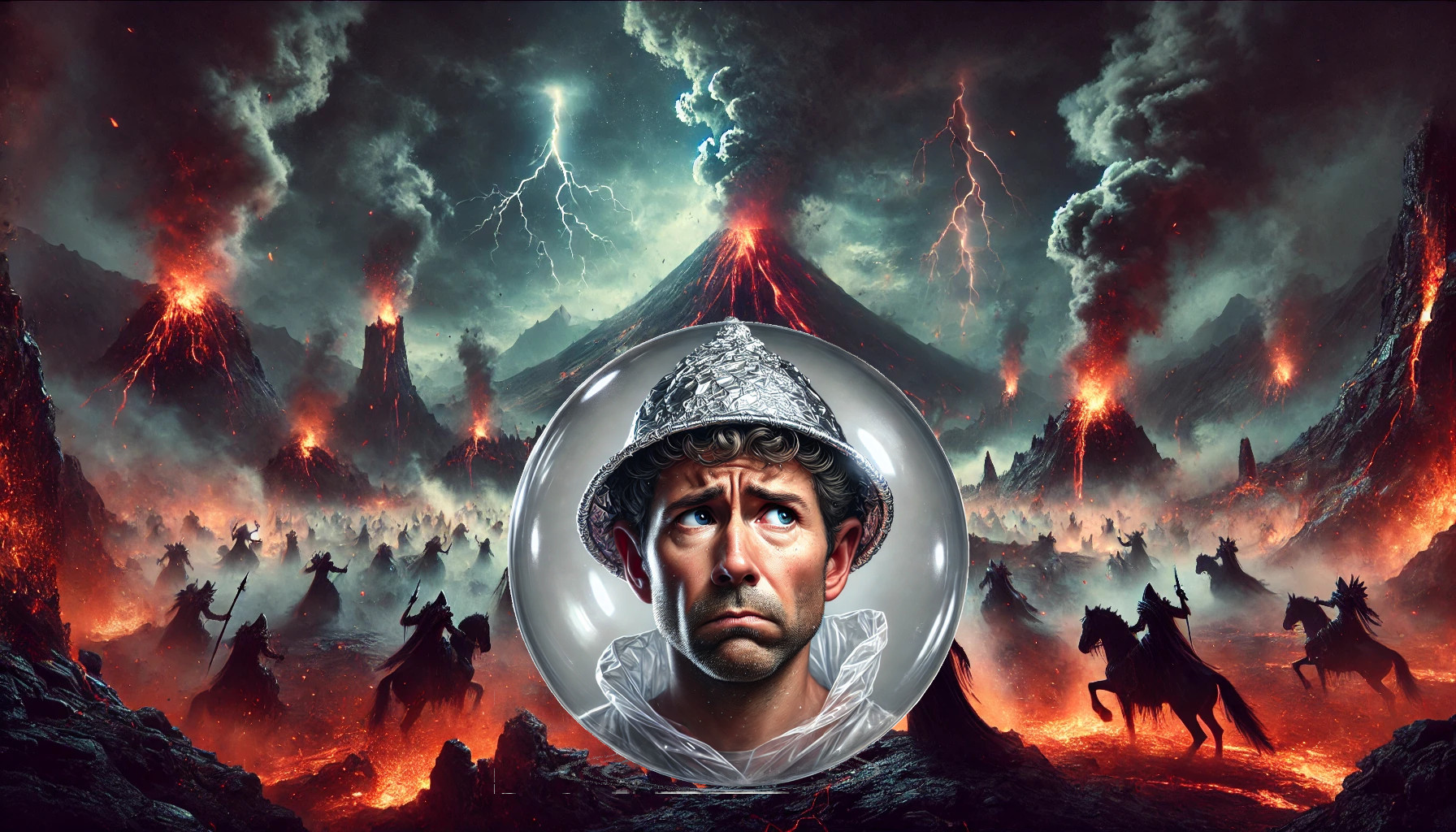
Frank Gurby is a good man. He believes in fairness, hard work, and honesty. He runs his small business with integrity, pays his employees well, volunteers at the local food bank every Saturday, and attends church every Sunday. He’s the kind of man who would pull over to help change a stranger’s tire in the rain. His friends and family know him as someone they can always rely on for sound advice or even just be smart and sympathetic when talking about a problem.
But when it comes to the world beyond his own backyard, Frank lives on Planet Dopamine—a place where every headline confirms his beliefs, every news article reassures him he’s right, and every post he shares makes him feel like he’s fighting the good fight.
It had happened so gradually that he didn’t notice. At first, he just wanted to be informed. He read the news every morning and clicked on articles that seemed important. But then, one day, he felt it—a twinge of satisfaction, a warmth spreading in his chest as he read an article confirming what he already knew. But soon, that little high wasn’t enough. He needed more—stronger headlines, clearer enemies, sharper outrage.
Soon, Frank stopped reading news that made him uncomfortable. He unfollowed old friends who shared statistics and facts contradicting what he “just knew” to be true. He removed the news feeds that occasionally made him second-guess himself. In their place, he subscribed to something better—a world where everything made sense, where he was always on the right side of history. The algorithms were happy to help.
Occasionally, Frank would falter. After a heated argument with a friend he respected, a troubling thought would creep in: “Am I brainwashed?” He could have taken the difficult path of self-reflection, questioning what he believed and why. But instead, nudged by social media platforms designed to prioritize engagement over truth, he retreated further into the comforting embrace of constant validation, where his biases were never challenged, only reinforced.
Then came Arthur Langfield.
The Dopamine Candidate
Langfield wasn’t like other politicians. He didn’t bother with empty niceties or fake humility. He made no apologies for his beliefs. Langfield spoke like a man who had unlocked the secret of history. “They want you to feel weak,” he told the crowd, voice thick with certainty. “But you are not weak. You are the backbone of this country. And I will never let them take that away from you.” He was the perfect candidate for Planet Dopamine.
Every day, Frank’s favorite news sites were filled with stories about Langfield’s heroism, his generosity, and his love for America. There were stories about how Langfield wrote letters to sick children, how he secretly funded homes for orphans. At the same time, the sites had stories of how Americans who disagreed with Langfield were not just wrong, but the enemies from within, who were out to destroy the country. Frank felt it again—that rush, that thrill of being part of something bigger. Of course, the mainstream media called those stories false. But wasn’t that just what they wanted Frank to believe?
Langfield had built his career on debt, fraud, and broken promises. The man who called himself “self-made” had inherited his wealth, and then squandered it through a long trail of bankruptcies that left countless unpaid debts. He had cheated small businesses for decades, refusing to pay contractors, caterers, and plumbers—anyone who couldn’t afford the legal costs required to get Langfield to pay what he owed them.
Langfield’s personal life was no different. He had cycled through multiple wives, cheating on each one in a long parade of affairs, including one with a sex worker while his latest wife was at home nursing a newborn.
As an honest businessman, great husband, and kind person, Frank would ordinarily be disgusted by someone like Langfield. But now, Frank had no interest in questioning him. That would mean stepping outside the world where he felt good.
“Everybody does it.”
Langfield’s corruption was sometimes too open to deny, even for Frank’s news sources. The news sites would immediately shift into whatabout mode, conjuring up a firehose of half-truths and outright lies about Langfield’s opponents to the point of exhaustion. Frank’s conclusion: “Sure, he did it, but everybody does it.” Put another way, since everyone is a crook, nobody is a crook.
Eventually, Frank’s sense of right and wrong when it came to Langfield became completely disconnected from his own life. Frank was fine with Langfield’s lying, bragging, mocking, cruelty, and punching down, even though he would call out such behavior immediately if he saw someone acting that way in person. Frank had become far too invested in Langfield. With every social media share, every affirmation, that investment grew. Admitting he was wrong would mean losing that investment. So when something threatened to pierce his information bubble, he didn’t question—it was easier to make the bubble thicker and stronger.
The Currency of Corruption
When Langfield became president, he found a way to make billions of dollars fast. Shortly before taking office, he launched a cryptocurrency: LangCoin. He called it “the future of American wealth,” a “currency for patriots.” But in reality, it was a perfect vehicle for foreign governments, oligarchs, and corporate interests to bribe the President of the United States.
Anonymous wallets holding billions of dollars worth of crypto would suddenly start buying LangCoin—always just before a major policy shift, a trade deal, a quashing of a court case, a lifted sanction, or a foreign military action.
Langfield cozied up to tyrants and strongmen, forming alliances with imperialist dictators who wanted an excuse to expand their empires. He pulled the U.S. out of treaties, shattered alliances, and mocked any nation that still believed in international law. “Why should we play by the rules?” he sneered at a rally. “The world belongs to those strong enough to take it.”
Frank cheered. Finally, a leader who wasn’t afraid to put America first!
And then, the wars.
Langfield’s new allies—dictators with dreams of empire—took his words as a green light. Wars of conquest erupted across the globe. Russia surged deeper into Eastern Europe. China seized Taiwan and swarmed the South China Sea. Dictators in Africa and South America, emboldened by Langfield’s disdain for international norms, launched brutal and bloody invasions of their smaller and weaker neighbors.
Each time a country prepared for an invasion, the pattern repeated itself: a sudden, multi-billion-dollar spike in anonymous purchases of LangCoin. Before the war in Eastern Europe. Before the attack on Taiwan. Before the coup in South America. Langfield would always place blame, not on the aggressor, but on those being attacked.
The Conquest of Panama
Although the U.S. had returned control of the Panama Canal to Panama under a treaty obligation, Langfield made it clear he wanted it back—and he was willing to use force to get it. Minutes after taking office, he vowed to “expand our territory” and said that military action was on the table. The words set off an alarm in Frank’s mind. But he quickly brushed it aside. “Langfield is a master negotiator,” he told himself. “This is just tough talk to get a better deal.”
Heated negotiations with Panama followed. Langfield’s so-called “final offer” was absurd: Panama could keep the canal—if it paid the U.S. one hundred billion dollars, which he claimed was its modern construction cost. But the real final offer came through back channels. Langfield, never one to leave money on the table, proposed a “suspension” of military action if Panama agreed to buy ten billion dollars worth of LangCoin. Panama, as a functioning democracy, couldn’t accept such a blatant extortion scheme. So Langfield gave the order to invade.
The Price of Addiction
Frank’s son, Ethan, had joined the army right after college, dreaming of a career in the military. He hoped they would send him to medical school. Ethan wanted to serve his country while treating injured soldiers and veterans. Frank, who had served in the army himself, could not be more proud of his eldest son and the type of young man he had grown into.
Although he had been accepted into med school and the army had already agreed to pay for it, the program was suddenly and inexplicably canceled. This put Ethan in a terrible position, making him lose his spot in medical school, but there wasn’t anyone to explain why the program was eliminated—they had all been fired. The Langfield administration claimed, without evidence, that the program was riddled with fraud and had to go in the interest of government efficiency.
At the same time, the army needed every soldier available to deal with an unexpected insurgency that erupted in Panama, made worse by Langfield’s policies, which favored heavy-handed tactics to crush resistance, and openly encouraged torture. Ethan was rushed to a combat unit in Panama.
Frank’s favorite news sites assured him the invasion was necessary. They assured him it was about protecting freedom, stopping terrorists, and saving America. The news sources said anyone who opposed the war was anti-American, corrupt, stupid, evil, or all of the above. But they weren’t anti-American, corrupt, stupid, or evil. They were simply people who dared to question the war. Frank’s news sites also said the war would be over in weeks. It wasn’t.
Ethan was killed in a jungle ambush outside Colón. When the officers came to Frank’s door, he barely heard the words. Regret to inform you… brave service… ultimate sacrifice. His wife collapsed. His daughter sobbed. But Frank just stared, numb.
Then came the words that cut even deeper. His daughter, shaking, tear-streaked, looked up at him. At first, her voice was barely a whisper.
“You did this.”
Frank flinched.
“You cheered for all of it!” she choked out, her voice rising. Her grief twisted into fury.
“You should have known it was bullshit. But you didn’t just believe it—you voted for it. Even when the corruption was right in front of you. Even when the evil was staring you in the face.” She let out a sharp, bitter laugh. “And now Ethan is dead. For what? The Langfield Canal?” Her voice broke. “We’re a country that sends soldiers to die smashing weaker nations just to build an empire.” She stared at him, eyes hollow, voice barely above a whisper. “Well, congratulations, Dad. You ‘won’ the argument.”
His wife didn’t speak. She didn’t need to. The way she looked at him—hollow, broken—was worse than any words.
Frank opened his mouth, but nothing came out.
That night, when he picked up his phone, his fingers shook. His mind screamed at him to put it down, to step away, to just sit with the truth for one unbearable moment. But the withdrawal was too strong. So he scrolled. And there it was—the relief.
“Panama Invasion: The Mainstream Media’s Lies”
“Langfield’s Bold Strategy Is Working—Here’s Why!”
Frank inhaled the words like oxygen. He needed them. Because to believe otherwise—to accept that Ethan had died for nothing but the vanity of one man, to admit he had become addicted to lies and had helped fuel the machine that destroyed his own son—was unthinkable. So he clicked. And shared. And reassured himself that he had been right all along. Because that was the thing about Planet Dopamine. It never lets you question. It only lets you feel. And Frank needed to feel that he had been right. Even after he lost his son. Even as the world continued to burn.
 Technophile Musings